.png)
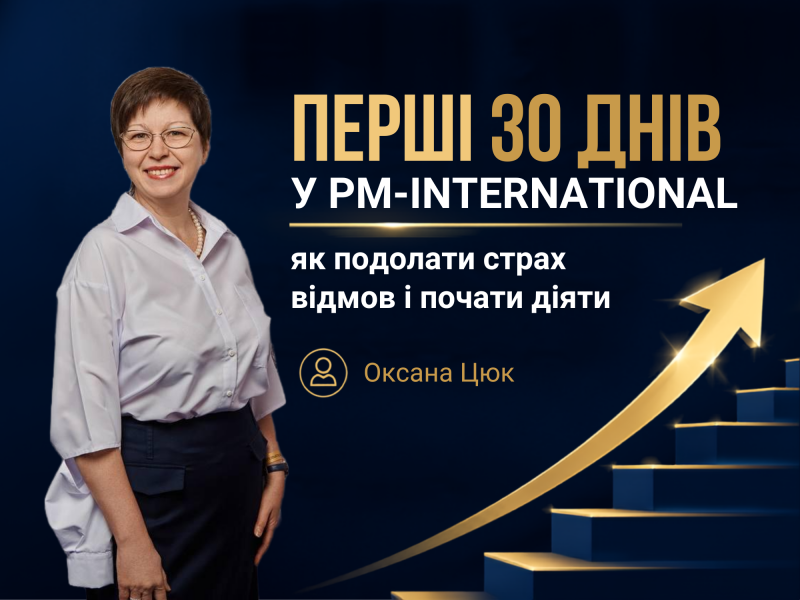
A new PM-International partner does not need to become fully confident first, learn every detail about the products, or know how to answer every question independently.
Confidence develops later — when a person begins using the products, takes the first simple steps, has conversations together with a mentor, observes people's reactions, and achieves an initial result.
That is why the first 30 days should be built not around a large volume of information, but around a clear system of action.
On July 25, 2026, I spoke at the Ukrainian PM-International Business Academy on the topic “The First 30 Days in the PM Business.” My presentation was officially announced on the PM-International Ukraine Telegram channel, and during the Academy the company published a separate post about my practical guidance for starting the business.
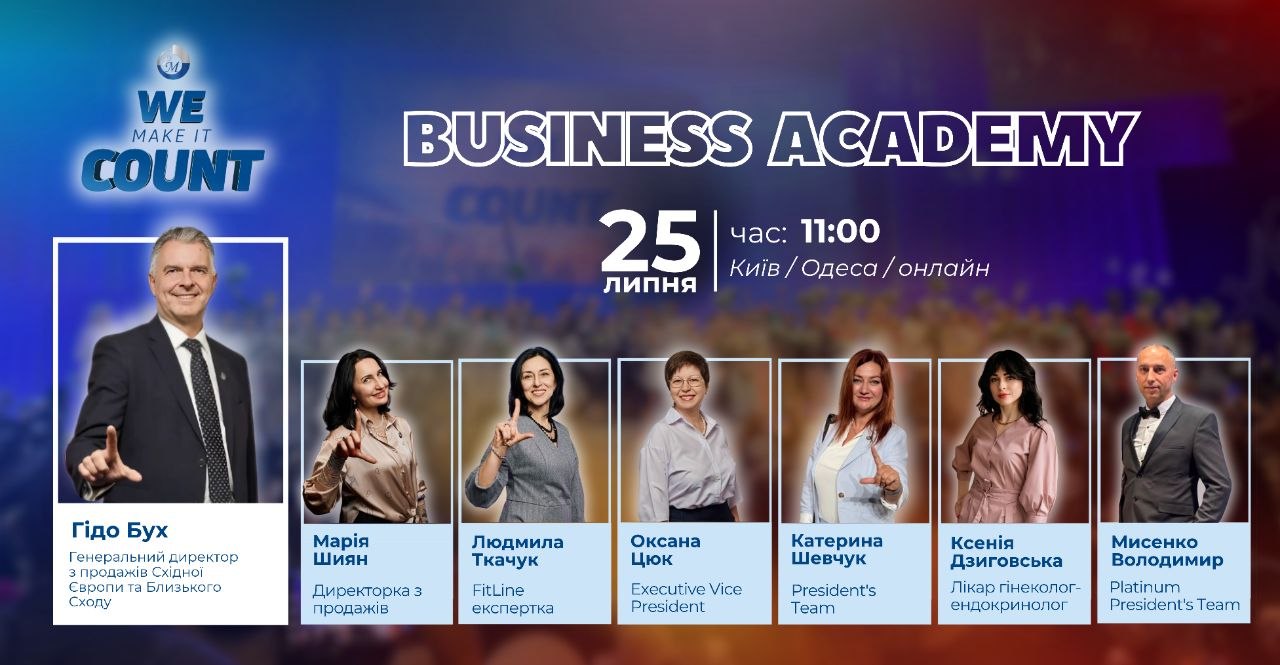
Oksana Tsiuk speaking at the PM-International Business Academy on the topic “The First 30 Days in the PM Business.”
Previous experience can sometimes make starting harder than having no experience
While preparing for the presentation, I remembered a partner who already had experience in network marketing. It might seem that starting again should have been easier for her. In reality, that previous experience created strong internal resistance.
She said:
“I have already been through this, and I do not want to hear ‘no’ from people I know again. I do not want to be seen as pushy.”
Her fear of rejection was accompanied by other doubts. She did not have a medical education, understood that she would need to learn about new products, and worried that FitLine's premium price level would be too high for her audience.
At the same time, she had a real personal need — to support her health with a high-quality product. Her new experience began with that personal need.
A natural recommendation begins with a shared topic
I do not teach people to begin a conversation with a product or business offer. The first step is to understand whether the topic is relevant to the person.
When the conversation is about products, I recommend first finding out whether health, energy, recovery, or maintaining daily vitality matters to the other person.
When the conversation is about partnership, it is appropriate to calmly ask whether additional income, building a business, or professional development is relevant to them.
A recommendation becomes natural when two people discuss a topic that genuinely matters to both of them. At that point, it is no longer pressure; it is an exchange of experience and opportunity.
Rejection is not a judgment of the person who made the offer
One of the most important responsibilities of a mentor, in my view, is helping a new partner develop a healthy attitude toward rejection.
My mentor once explained a practical 20/20/60 model to me: in broad terms, some people will be interested immediately, some will decline, and the largest group will want to think, return to the topic later, or watch for a while.
I use this model as a practical explanation, not as universal statistics. Its main point is that one “no” says nothing about the value of the partner, the product, or the business opportunity.
A person may decline because the timing is wrong, other priorities are more important, there is no current need, or they do not yet have enough information. It is their decision in a specific situation, not an evaluation of you as a person.
Every conversation contributes to the overall result
In a partnership business, results are not created by one perfect conversation. They are built through a sequence of contacts, meetings, responses, follow-ups, and recommendations.
That is why I often describe this as a business of statistics: every conversation adds experience and brings you closer to people for whom the offer will be timely.
This does not guarantee income or the same result for everyone. Outcomes depend on personal actions, time, skills, consistency, and individual circumstances. But without conversations and practical steps, results will not appear.
Use — Talk — Demo: a simple model for getting started
At the beginning, I give a new partner a simple model: Use — Talk — Demo.
Use
The starting point should be personal experience. When a person uses the products consistently and pays attention to how they feel, it becomes easier to speak sincerely and without memorized phrases.
Talk
There is no need to deliver a complex presentation right away. It is enough to speak about personal experience, ask questions, listen to the other person, and invite them to a meeting with a mentor.
Demo
People understand more easily what they can see in real life: how you use a product, how you organize your day, or how a consultation or joint meeting works.
This model reduces pressure on the new partner. There is no need to pretend to be an expert. The task is to build personal experience consistently and share it within the limits of one's competence.
How personal experience changed the partner's attitude toward the business
After registering, the partner began using the FitLine Optimal Set regularly. It includes Basics, Activize Oxyplus, and Restorate Citrus. Her own experience with the products became an important source of confidence: she could now talk about FitLine based on personal observations rather than repeating someone else's words.
According to her, she noticed positive changes in how she felt, her recovery, and her appearance. This is her individual experience and should not be interpreted as a promise of the same result for other people.
View the contents and current price of the Optimal Set on the official PM-International website.
Her family members and colleagues also noticed the changes. Questions about her experience began to arise naturally, without pushy offers. This led to her first customers, first partners, and first company bonus.
The most important change was not only her first result, but also a new perception of the business itself: it stopped feeling like pressure and became clearer and more enjoyable.
Does a partner need a medical education?
My university degree in medicine helps me work with information systematically, recognize professional boundaries, and approach health-related topics responsibly. However, a new partner does not need a medical education to begin.
The role of a Team Partner is to use the products, share personal experience, rely on the company's official information, ask the mentor questions, and stay within the limits of their competence.
Questions about medical conditions, diagnosis, treatment, compatibility with medicines, and individual medical risks should remain within the responsibility of qualified healthcare professionals.
A partner should not decide for the customer what is “too expensive”
Another common fear is FitLine's premium price level.
A new partner often judges other people's financial choices through the lens of their own budget and decides in advance that the product is too expensive for them. As a result, the person is not even given the opportunity to evaluate the information independently.
The partner's task is to explain the product, how it is used, the available options, and the value of support clearly and correctly. The customer decides what is important and affordable for them.
Why training materials alone are not enough
I once had a partner who attended training regularly, listened to presentations, and accumulated information, but did not move on to practical action.
The problem was not a lack of knowledge. She was afraid to take the first step on her own.
I suggested that we host a live Instagram session together for her audience. She saw that support was available, that she did not have to answer every question alone, and that a new experience could be positive.
After that shared action, she became much more engaged. For me, this confirmed an important principle: sometimes a new partner does not need another lecture, but an experience that creates the feeling, “I can do this.”
In psychology, this belief in one's ability to perform a specific action is called self-efficacy. Psychologist Albert Bandura linked its development to mastery experiences, observing others, verbal encouragement, and a person's physiological and emotional state. That is why an achievable first result can change a new partner more powerfully than another lecture.
This practical conclusion is consistent with the broader principle of active learning. A meta-analysis of 225 studies found advantages of active engagement compared with predominantly passive listening. The research was conducted in academic settings, so I do not apply its findings directly to a partnership business. However, the underlying mechanism is clear: knowledge is retained more effectively when people apply it in practice.
What is PM.GID?
PM.GID grew out of a real need. I found myself repeatedly explaining the same basic topics to new partners, showing them how to navigate the system, and answering the same initial questions.
PM.GID is my 30-day onboarding and support system for new PM-International partners. Each day, the partner receives a short piece of material that usually takes 5–10 minutes to review:
- short messages;
- videos and mini-lessons;
- simple practical tasks;
- guidance on navigating PM Office;
- explanations of events, orders, and FitLine Club;
- guidance on referral links;
- an explanation of the virtual warehouse;
- the basics of placing orders in different countries.
The person is not given a large volume of information all at once. Instead, they see one clear next step and gradually become familiar with the system.
PM.GID complements the mentor
PM.GID does not replace personal mentorship.
The system provides consistency, structure, and access to essential information. The mentor is responsible for what an automated tool cannot do:
- help the partner identify a personal goal and direction;
- answer individual questions;
- join three-way meetings;
- help conduct the first presentations;
- support customer and partner registrations;
- work through real situations and objections.
Thanks to PM.GID, I do not have to spend most of my time repeatedly explaining the technical basics and can focus on personal work with each partner.
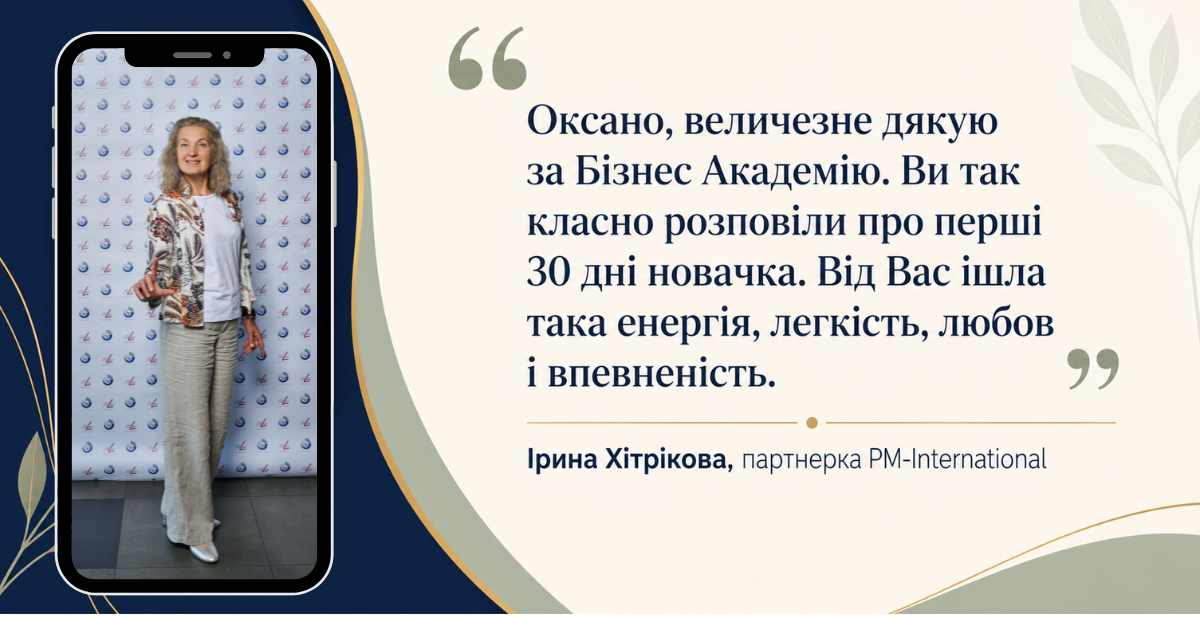
Feedback from Iryna Khitrikova, a PM-International partner, after Oksana Tsiuk's presentation at the Business Academy on July 25, 2026.
What I consider a successful first month
A successful first month does not necessarily mean a high income or a senior qualification. First and foremost, it is a transition from uncertainty to a clear system of action.
The partner can navigate the system
They know where to find PM Office, how to use its main sections, place orders, and locate the necessary official information.
They have personal product experience
The partner uses the products regularly, observes their own experience, and can talk about it calmly without exaggeration.
They take simple daily actions
The person does not wait for inspiration. They use the products, learn in short blocks, have conversations, make invitations, and involve the mentor when needed.
They share their journey on social media
They do not create the image of a perfect expert. Instead, they honestly show their first experience with the products, training, meetings, and initial practical steps.
They begin attracting their first customers and partners
For some active new partners, the first month may end with a Sales Manager or Marketing Manager qualification and their first commissions. In my practice, successful starts have sometimes resulted in approximately €200–€500 in commissions, but this is not a guaranteed result or a forecast for every person.
The scale of the company does not remove personal responsibility
PM-International provides products, infrastructure, training, and an international system. However, no company and no mentor can take daily action on behalf of the partner.
The company can provide an opportunity. A mentor can create a clear path and offer support. PM.GID can remind the partner of the next step each day. But the decision to use the system, talk to people, learn, and act remains the partner's personal responsibility.
Who this starting format is suitable for
This format is suitable for a person who is ready to:
- set aside time for short daily actions;
- use the products and build personal experience;
- learn gradually instead of waiting until they feel completely ready;
- communicate with people without pressure;
- accept support from a mentor;
- take responsibility for their own actions.
This format will not produce the expected result for someone who wants ready-made income without consistent action or wants to transfer all responsibility to the mentor and the system.
The main result of the first 30 days is the feeling, “I can do this”
The first 30 days of a new partner are not about being perfect.
They are about:
- making a personal decision to begin;
- building personal experience with the products;
- using the simple Use — Talk — Demo model;
- developing a calm attitude toward rejection;
- taking consistent daily action;
- following the PM.GID structure;
- receiving personal mentor support;
- achieving the first practical results.
Confidence rarely appears before the first step. It develops through action — when a person sees that they can understand the system, have a conversation, invite someone to a meeting, receive a response, and continue moving forward.
Are you considering a partnership with PM-International but unsure whether you can do it?
Go to PM.GID to see how the first 30 days of a new partner are organized in my team. You will receive a daily focus, step-by-step instructions, ready-to-use message templates, and short learning materials designed to help you become involved gradually while working with a mentor.
About the author
Oksana Tsiuk is an entrepreneur since 2005, holds a university degree in medicine, serves as Director of Fitocentr and Executive Vice President at PM-International, mentors partners in 16 countries, speaks at Business Academy events, and created the 30-day PM.GID onboarding system for new partners.
Comments:
Recommended articles

€1 Million in July 2026: What PM-International Ukraine’s Record Shows About Demand for FitLine
On August 1, 2026, the official PM-International Ukraine Telegram channel reported a new result: in July, the Ukrainian structure reached €1 million in turnover. An important detail for me was that July was a non-promotional month. Official PM-International Ukraine announcement. When I saw the news, I was genuinely excited. But almost immediately, I stopped thinking about rankings..